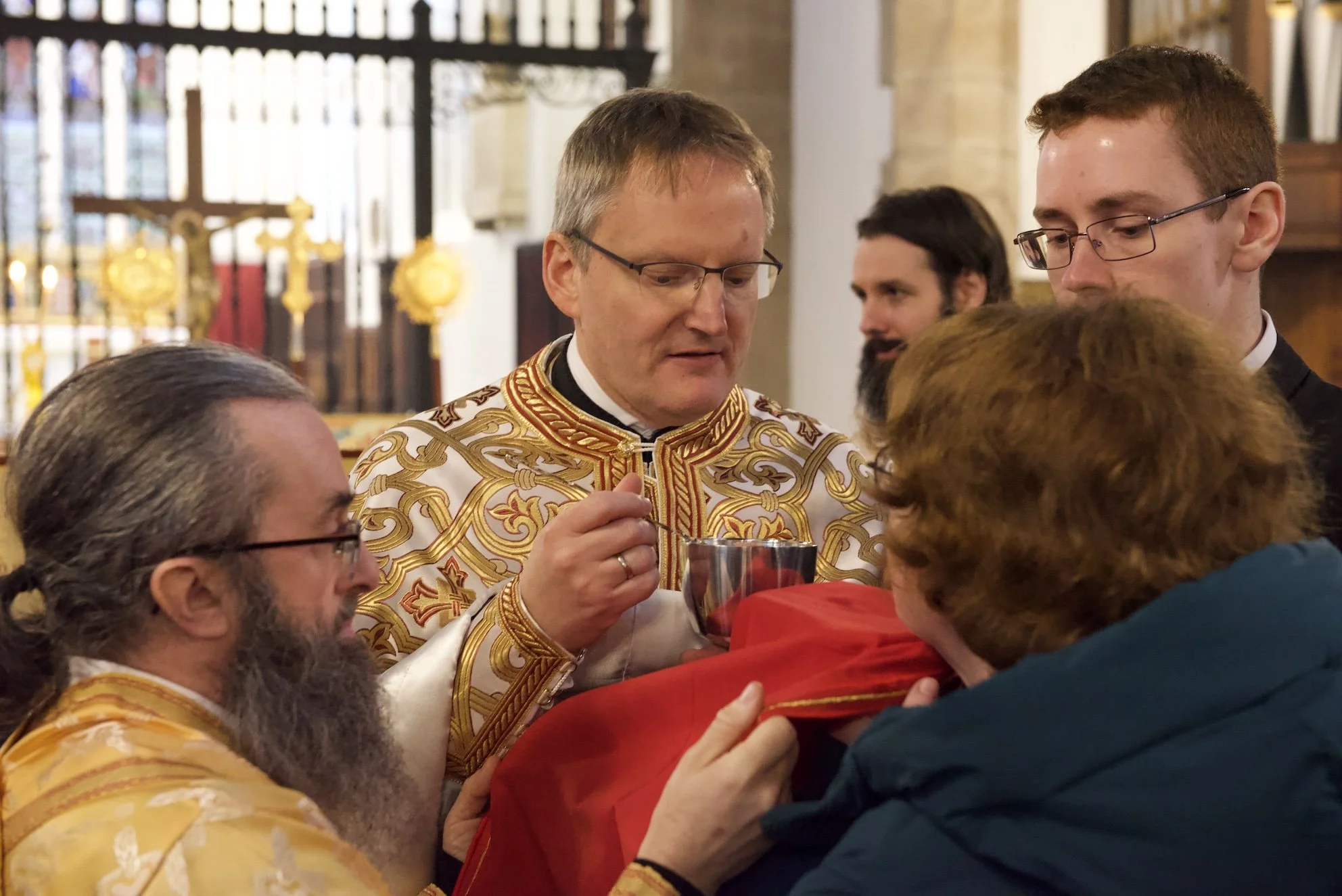
The Eucharist Holy Communion
The Center of Church Life
In the Orthodox tradition, the Holy Eucharist is known as the "sacrament of sacraments." It is the heartbeat of the Church—the source from which all doctrines flow and the goal toward which all other sacraments lead. It is not merely a ritual, but the completion of the Church's life.
Roots and Transformation
The Christian Eucharist is rooted specifically in the Jewish Passover.
The Old Passover: A meal commemorating the Israelites’ liberation from Egyptian slavery.
The New Passover: At the Last Supper, Christ transformed this meal. It became a remembrance of His life, death, and resurrection—the "New Passover" that frees humanity from sin and death, transferring them into the Kingdom of God.
The Meaning of "Eucharist"
The word Eucharist literally means "thanksgiving." This term applies not just to the bread and wine, but to the entire gathering: the prayers, the reading of Scripture, and the act of communion. It is a total offering of thanks to God for creation and salvation.
The Mystery of Real Presence
The Orthodox Church strictly teaches that the elements are the Real Presence—the true Body and Blood of Christ. However, it avoids rationalistic explanations that create a conflict between what is "real" and what is "symbolic."
Beyond Mental Recollection: Orthodoxy rejects the idea that the Eucharist is merely an intellectual reminder or a psychological symbol. If it were, communion would only be a "thought" about Jesus rather than a union with Him.
True Symbolism: The Orthodox define "symbol" in its ancient sense: "to bring together into one." Reality and symbolism are not opposites; rather, the material world is meant to reveal God. Therefore, the bread and wine are the genuine Body and Blood because they are the mysteries that manifest God's presence.
Practical Guidelines for Reception
Who can receive?
Orthodox Only: Communion is reserved for Orthodox Christians in good standing who have the blessing of their spiritual father.
Exclusivity: An Orthodox Christian cannot receive communion in a non-Orthodox church, nor can non-Orthodox receive in the Orthodox Church.
How to Prepare? St. Paul warns against receiving in an "unworthy manner." Preparation involves both spiritual and practical disciplines:
Spiritual Requirements:
Fear of God: Deep reverence and respect for the Mystery.
Faith: Belief that this is truly Christ's Body and Blood.
Love: You cannot draw near to the Chalice while holding resentment. Reconciliation with others is a prerequisite (Matthew 5:23).
Practical Discipline:
Fasting: Ideally total abstinence from food and drink from midnight on the day of Communion.
Prayer: Reading the specific Prayers of Preparation for Holy Communion.
Punctuality: One must strive to be present for the entire Liturgy (at absolute minimum, from the Epistle and Gospel readings).
Confession and Frequency
Frequency: Faithful are encouraged to commune regularly (whenever Liturgy is served), not just a few times a year.
Confession: Regular confession is required, but a strict 1:1 ratio is not necessary (i.e., you do not need to go to Confession before every single Communion if you are communing frequently and have a blessing to do so).
Attitude: Communion is "medicine for the sick, not a prize for the perfect." We approach not because we are worthy, but because we need Him.