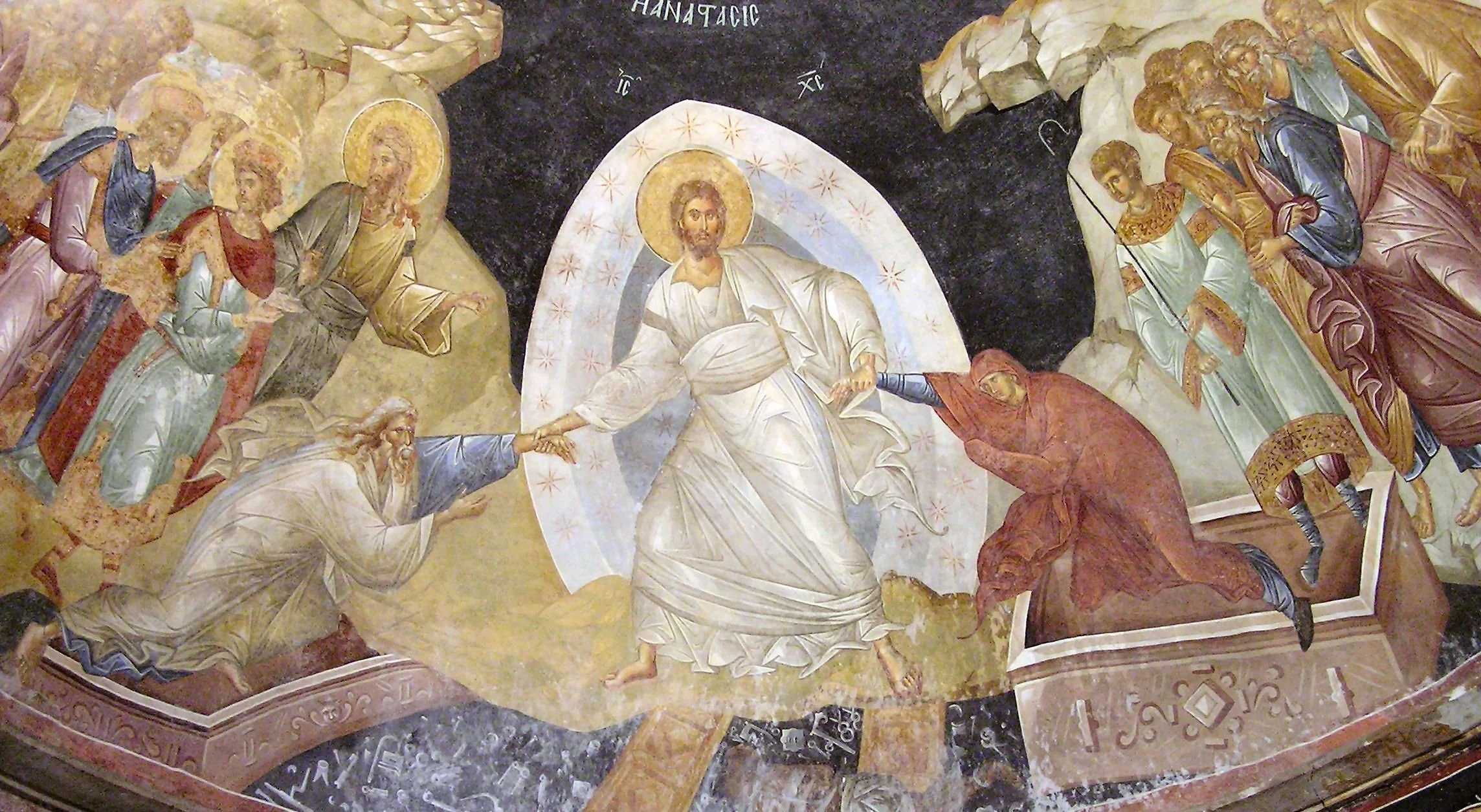
PASCHA
The Feast of Feasts
From the quiet, lingering expectation of Great and Holy Saturday, we are brought to the very climax of the Church’s liturgical year. Pascha (Easter) is not simply one feast among others; it is the "Feast of Feasts" and the "Triumph of Triumphs." If the preceding days were the gradual revelation of Christ’s descent into the darkness of death, Pascha is the explosive revelation of His definitive victory.
The Midnight Procession: From Darkness to Light
The Paschal service begins in the deep of the night. The church is plunged into complete darkness, a profound and heavy silence that symbolises the tomb of Christ and the despair of a world enslaved by sin and death. We are waiting.
Then, at midnight, the Royal Doors open, and a single light appears. The priest comes forward carrying the Paschal candle, chanting the invitation:
"Come ye and receive light from the unwaning Light, and glorify Christ, Who is arisen from the dead!"
From this single flame, the light is passed to the candles of the faithful. Within moments, the dense darkness is entirely dispelled, replaced by a sea of warm, flickering light. This is the visual reality of the Resurrection: the Light of Christ shining in the darkness, and the darkness comprehending it not (John 1:5).
We then leave the church in a solemn procession, circling the building. This procession represents the myrrh-bearing women making their way to the tomb early in the morning, while it was still dark. But it also represents the whole of humanity, led by the Church, journeying out of the darkness of the fallen world and arriving at the sealed doors of the Kingdom.
The Proclamation of Life
Outside the closed doors of the church, the Gospel of the Resurrection is read. And then, for the first time, the triumphant hymn of Pascha is sung, the Troparion that will echo through the Church for the next forty days:
"Christ is risen from the dead, trampling down death by death, and upon those in the tombs bestowing life!"
With the cross, the priest strikes the doors, and they are thrown open. We re-enter the church, which is now ablaze with light, adorned with flowers, and filled with the scent of incense. The closed doors of the church have become the shattered gates of Hades. Christ has forced open the way to Paradise, and we are invited to enter.
The Liturgy of the New Creation
The Matins and the Divine Liturgy of Pascha that follow are characterised by an overwhelming, almost breathless joy. The dark vestments of Lent have been entirely replaced by bright white. The Royal Doors remain fully open for the entire Bright Week—a powerful symbol that the veil of the temple has been torn, the tomb is empty, and the barrier between God and man has been permanently destroyed.
During the service, the famous Paschal Homily of St. John Chrysostom is read, summarising the absolute and unconditional nature of Christ’s victory. It is a triumphant taunt against death itself:
"Let no one fear death, for the Saviour’s death has set us free."
"O Death, where is thy sting? O Hades, where is thy victory?"
"Christ is risen, and the angels rejoice! Christ is risen, and life reigns!"
The Eighth Day
What does this mean for us today? Pascha is not merely a historical re-enactment of something that happened two thousand years ago in Jerusalem. It is the inauguration of the "Eighth Day," the new creation.
Through the Paschal Liturgy, and most fully through our participation in the Eucharist, we are lifted out of the linear, decaying time of "this world" and brought into the eternal, unsetting day of the Kingdom of God. The Risen Lord is present among us, offering Himself as the Bread of Life.
We realise that although we still live in a world where physical death, sickness, and sorrow exist, their absolute power has been broken. Death is no longer a dead end; it has become a Passover, a passage into eternal life. We leave the Paschal celebration not just with a memory of a past event, but carrying the reality of the Risen Christ within us, tasked with bearing His unwaning light into the world.
The Vespers of Love (Agape)
On the afternoon of Pascha Sunday, the Church gathers once more for the Vespers of Love, often called the Agape Vespers. This beautiful service sustains the unbroken joy of the midnight Liturgy but shifts our contemplation toward the universal and transformative impact of the Resurrection. The defining liturgical moment of this service is the reading of the Gospel (John 20:19-25), which recounts the Risen Christ appearing to His fearful disciples behind closed doors and bestowing upon them His peace. Uniquely, this Gospel passage is proclaimed in as many different languages as possible by the clergy and the faithful. This multilingual recitation is not merely a colourful tradition; it is a profound theological statement. It symbolises that the joyful tidings of Christ’s victory over death cannot be contained by any single nation or culture. The Resurrection is a cosmic event that shatters all earthly divisions. In this Vespers, we experience the reality that the Risen Lord has restored humanity to true communion—true agape—sending us out to carry His peace and light to the very ends of the earth.