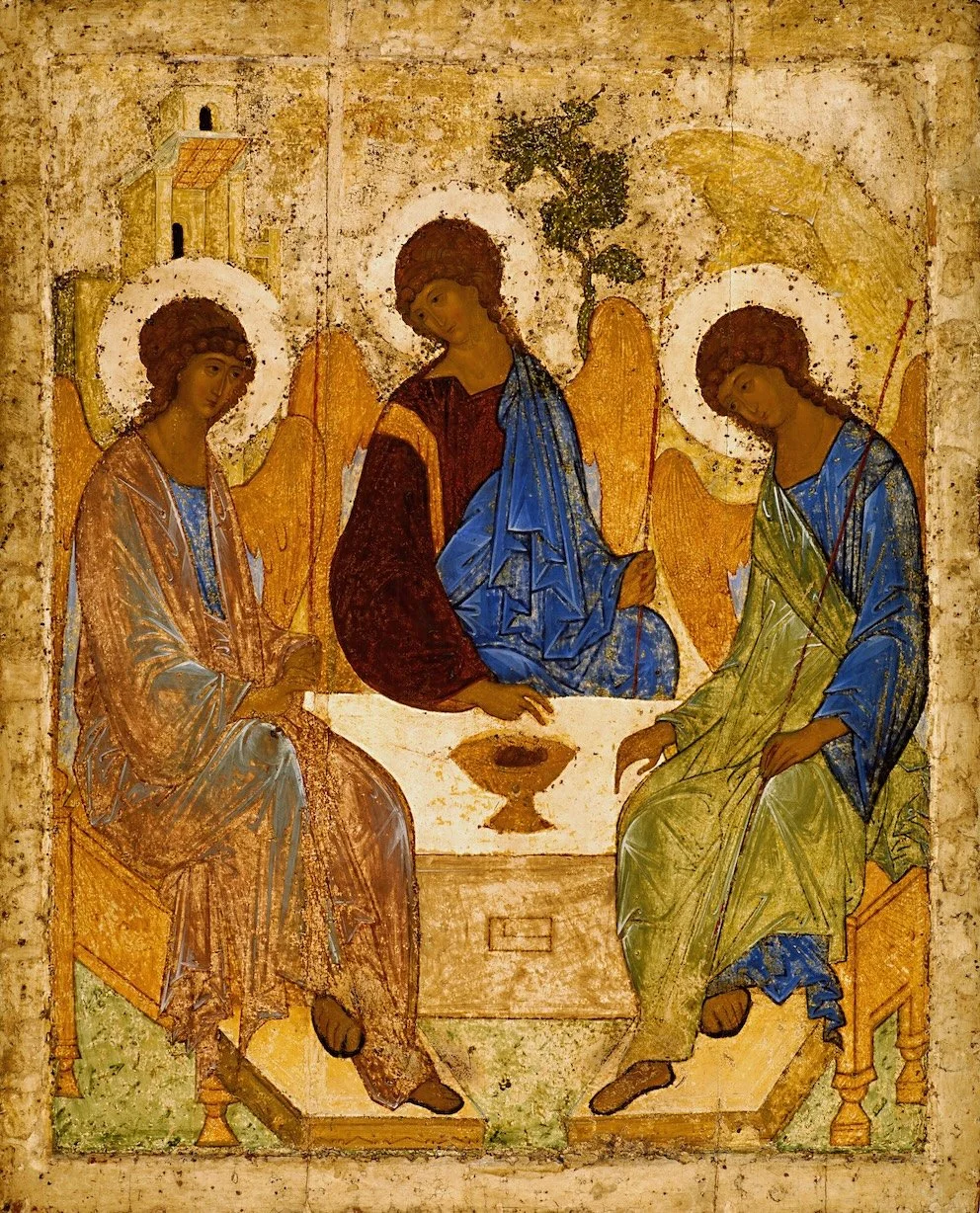
Holy Trinity
The Nature of the Doctrine
The mystery of the Holy Trinity is not an invention of scholars or a mere intellectual puzzle. It arises from the lived experience of the saints and their direct encounter with God. To know the Trinity is not just to accept a definition, but to experience the living reality of God.
One God, Three Persons
The central mystery of the Orthodox faith is that God is One in Essence but Three in Persons.
"What" is God? (Nature/Essence): God is one, infinite, eternal, and absolute. There is only one divine nature, one divine essence, one divine energy, one divine purpose, one divine will, and one divine action.
"Who" is God? (Person/Hypostasis): God is the Father, the Son, and the Holy Spirit. “Each person of the Three however has distinctive characteristics.”*
The Father as the source
Orthodox theology emphasizes that there is One God because there is One Father. The Father is the eternal source and cause of the Godhead:
“The Father is Unbegotten, that is to say he is the source and origin of his divinity - he is not 'begotten' of any one or anything. It is therefore supremely apt to call him 'Father'.
The Son is Begotten, that is to say, though he is fully God, fully equal with the Father and co-eternal with him, his source and origin is, mysteriously, in the Father. He is eternally begotten, 'before all ages'. He never had any sort of beginning as we understand it in time. It is supremely apt to call him the Son.
The Holy Spirit proceeds from the Father, that is to say he too has his source and origin in the Father but in a way different from that of the Son. He is distinct from the Son; he is not begotten; so a different word is used for his mode of origin, namely that he proceeds from the Father.
This language is very mysterious. It takes time to understand. We only have language taken from earthen, created reality to speak about something which is entirely not of this earth and not created. What the language is saying is that the Father, Son and Holy Spirit are distinct persons even though, as God, they are one.”*
Because the Son and the Spirit originate from the Father eternally with no beginning and share His exact nature, they are not separate gods, nor are they "lower" than the Father. They are consubstantial (of one essence) and equal in glory. God was always a Holy Trinity.
God is Love
The Bible states that "God is love" (1 John 4:8). This is not just a description of His actions, but His very being.
True love requires a relationship (a lover and a beloved).
If God were a solitary individual (a "unit"), He could not be love in Himself; He would need creation to have something to love.
Because God is a Trinity, He exists eternally as a communion of love between the Father, Son, and Holy Spirit.
Common Misconceptions
Specific wrong doctrines (heresies) that the Church rejects:
Creationism (Arianism): The idea that the Son and Spirit are created beings (like angels), not fully God. Correction: They are uncreated and co-eternal with the Father.
Modalism: The idea that God is one person who merely appears in three different "masks" or modes (sometimes as Father, sometimes as Son). Correction: The three Persons are eternally distinct and real, not temporary roles.
Tritheism: The idea that there are "three gods." Correction: There is only one divine Nature and Will; they are perfectly united and never divided.
The Trinity in Action
Every action of God toward the world is a single action performed by all three Persons together.
“The Father is the Source of every gift in creation to us; and his love for us is such that he desires all people & all things to be reconciled with him and united with him in his love for eve
The Son is the one who shows us the Father and reveals the Father's love to us; who, being born as man, has removed all that separates us from the Father; and is the one who, in his obedience, brings all things into the unity of the Father's love, in love for him.
The Holy Spirit is sent by the Father to gather and turn the whole creation towards the Son in faith, hope, and love, so as to bring the Son's work to completion, in love for him and the Father.”*
*Quotations taken from ‘An Orthodox Handbook’ by the late Father John Musther, Keswick