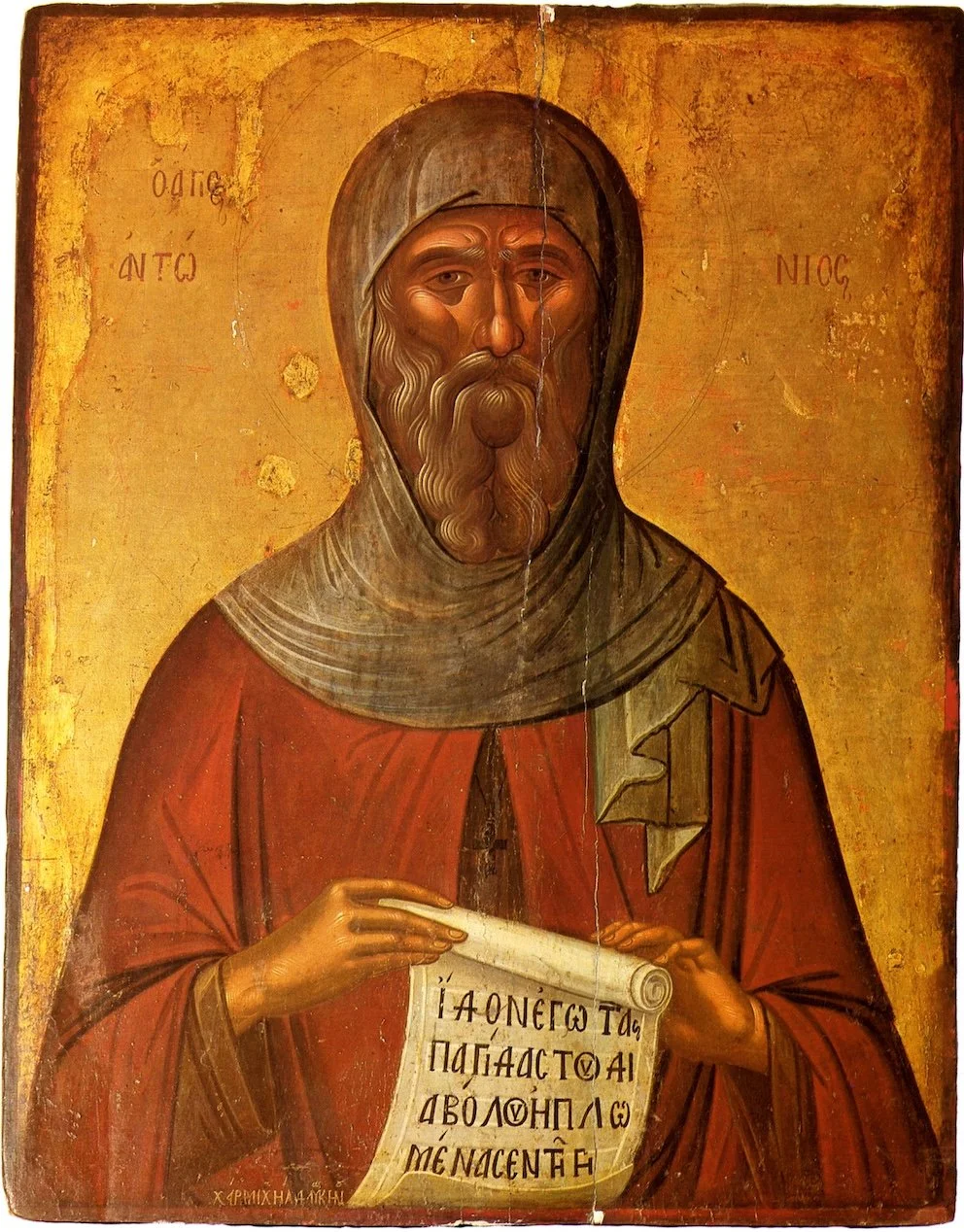
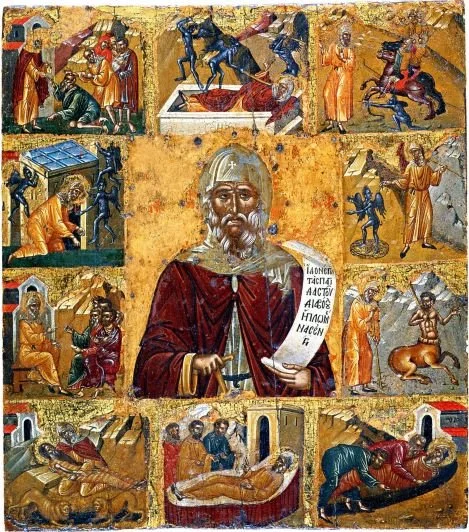
Saint Anthony the Great
Known in the Orthodox Church as Anthony the Great or the Father of Monasticism, he lived to the remarkable age of 105 (c. 251 – 356 AD). He is the archetype of the Christian ascetic. While there were hermits before him, Anthony was the first to withdraw completely into the deep desert (eremos), initiating the movement of desert monasticism that shapes Orthodoxy to this day. His feast day is celebrated on 17 January.
St Athanasius and the Life of Anthony
Our primary knowledge of St Anthony comes from the biography written by St Athanasius the Great, the Patriarch of Alexandria.
A Personal Connection: Athanasius was not merely a biographer; he knew Anthony personally and spent time serving him as a disciple in the desert.
The Blueprint: Written around 360 AD, The Life of Anthony became the definitive “handbook” for monastic life. It depicts Anthony not just as a man, but as a “God-bearer” whose life was in absolute harmony with divine truth.
The Sheepskin: Upon his death, Anthony left his sheepskin cloak to Athanasius. This gesture symbolised the transfer of his spiritual mantle to the great defender of Orthodoxy, linking the ascetic power of the desert with the dogmatic authority of the Church.
The Temptations (Spiritual Warfare)
In the Orthodox tradition, Anthony’s temptations are understood not as psychological hallucinations, but as genuine spiritual warfare against demonic powers.
The Tombs: Early in his asceticism, Anthony lived in burial tombs near his village. There, the demons physically attacked him, beating him so severely that he was left for dead and had to be carried out by friends. When he revived, he demanded to be taken back to the tomb to continue the fight.
The Gold and Silver: The devil attempted to entrap Anthony through the allure of wealth, placing piles of silver and gold in his path in the deep desert. Anthony recognised these as snares of the enemy and passed them by, causing them to vanish like smoke.
The Divine Vision: During one intense struggle with demons in the form of wild beasts, a beam of light descended, scattering the demons and healing his wounds. Anthony asked Christ, “Where were you? Why did you not appear at the beginning to make my pains cease?” The Lord replied: “I was here, Anthony, but I waited to see your fight; and since you have endured, and have not been worsted, I will ever be a succour to you, and will make your name known everywhere.”
The Sayings of Saint Anthony
St Anthony’s wisdom is preserved in the Sayings of the Desert Fathers (Apophthegmata Patrum). His teaching emphasises humility, discernment, and the constant remembrance of God.
On Humility: In a famous vision, Anthony saw the whole world covered with the snares and traps of the devil. He cried out, “Oh good Lord, who may escape from these?” A voice replied to him: “Humility.”
On the World: When Emperor Constantine wrote to him seeking prayers, Anthony was unmoved. He told his disciples not to be impressed that a ruler wrote to them, but rather to marvel that God wrote a law for mankind. He replied to the Emperor, advising him not to value this world but to remember the judgement to come.
On Perfection: His life began with the literal application of the Gospel: “If you want to be perfect, go, sell what you have and give to the poor” (Matthew 19:21). This absolute renunciation is the foundation of the Orthodox monastic “angelic life.”
Meeting St Paul of Thebes
A central event in Orthodox iconography is the meeting of Saint Anthony and Saint Paul of Thebes.
The Raven: Towards the end of his life, Anthony was led into the deep desert to find Paul, a hermit who had lived there even longer than he had. They greeted each other by name, though they had never met. As they spoke, a raven flew down and dropped a whole loaf of bread between them. Paul explained that for 60 years the bird had brought him half a loaf, but now that Anthony had come, Christ had sent a double portion.
Burial: When Paul died, Anthony buried him using the cloak given to him by St Athanasius, while two lions appeared from the desert to help dig the grave.