The Orthodox Church
The Meaning of "Orthodoxy"
The word Orthodox is derived from the Greek words orthos ("right" or "correct") and doxa ("belief" or "glory"). To be Orthodox, therefore, means to hold the "right belief" and to offer "right glory" (worship) to God.
The Church is called Orthodox because its primary mission is to preserve, uphold, and proclaim the fullness of the Christian faith exactly as it was handed down from the Apostles. In a world of changing philosophies and fragmented truths, the Orthodox Church distinguishes itself as the community that has maintained the Apostolic Faith without addition, subtraction, or alteration. It is not merely a denomination among many, but the continued presence of the One, Holy, Catholic, and Apostolic Church in history, possessing the fullness of the truth and the fullness of grace.
The Nature of the Church
The Church (Ekklesia) is not a human social movement, a religious club, or simply a building made of stone (which is more properly called a temple). It is a divine institution founded by Jesus Christ Himself, who promised, "I will build my Church" (Matthew 16:18).
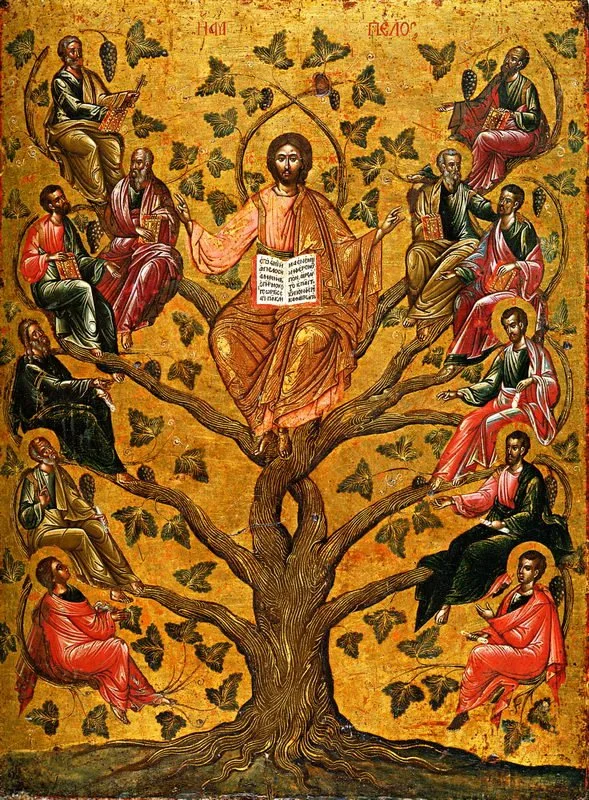
The most profound biblical image of the Church is the Body of Christ. This reveals that the Church is a living organism where Christ is the Head and the faithful are the members. It is the extension of the Incarnation through history, uniting humanity to God and to one another. This Body exists in two states:
The Church Militant: The faithful currently alive on earth, who are "fighting the good fight" and striving to attain holiness.
The Church Triumphant: Those who have finished their course and attained holiness, including the Virgin Mary, the Prophets, Apostles, Martyrs, and Saints.
The Four Marks of the Church
The Nicene Creed identifies the true Church by four specific, non-negotiable attributes:
1. One: Just as there is only one Christ, there can be only one Body. The Church is indivisible, united by one Lord, one faith, one baptism, and one Eucharist. While we may speak of "churches" in the plural (e.g., the Church of Greece, the Church of Russia), these are not separate denominations but local manifestations of the single, universal Body.
2. Holy: The Church is holy not because its members are morally perfect, but because its Head, Jesus Christ, is holy. The function of the Church is to sanctify sinners. In the Divine Liturgy, the priest exclaims "The holy things for the holy," inviting the faithful to become what they are called to be by participating in the sanctity of God.
3. Catholic: The term Catholic comes from the Greek katholikē, meaning "whole" or "complete." It does not refer merely to geography (universality). The Church is Catholic because she possesses the fullness of the faith. She lacks nothing required for salvation. In the Orthodox Church, the believer has access to the complete truth and the full means of grace to enter into union with God.
4. Apostolic: The Church maintains a direct, living continuity with the Apostles of Christ.
Apostolic Succession: Every Orthodox bishop can trace his ordination in an unbroken chain back to the Apostles.
Apostolic Tradition: True apostolicity requires preserving the teaching and way of life of the Apostles. It is like a torch passed from generation to generation: the "torch" is the institutional succession, but the "fire" is the Truth. A church that has the succession but has lost the Truth is like a torch that has gone out.
Membership and Governance
Membership in the Church is not a matter of paperwork but of spiritual incorporation into Christ. It begins with Baptism (dying to the old self), is sealed by Chrismation (receiving the Holy Spirit), and is sustained by the Eucharist(receiving the Body and Blood of Christ).
Conciliar Governance Unlike the centralised structure of the Roman Catholic Church, which is organised around the supreme authority of the Pope, the Orthodox Church is decentralised and conciliar. Following the model of the Apostles at the Council of Jerusalem (Acts 15), decisions regarding faith and discipline are made by bishops gathering in Synods (Councils).
Equality of Bishops: All bishops are sacramentally equal. There is no "super-bishop" with universal jurisdiction.
The "First" (Protos): To ensure unity and order, bishops of a region acknowledge a "head" (such as a Patriarch or Archbishop). This leader is "first among equals." He presides over the council to maintain unity but cannot interfere in the internal affairs of another bishop's diocese without consent.
Organization: Autocephaly and Jurisdiction
The worldwide Orthodox Church is organised into Autocephalous ("self-headed" or self-governing) Churches. These are administrative units usually defined by national or geographical boundaries.
The Ancient Patriarchates: Constantinople (New Rome), Alexandria, Antioch, Jerusalem.
The Modern Patriarchates: Russia, Serbia, Romania, Bulgaria, Georgia.
These are not rival churches but parts of the same whole. A Russian Orthodox Christian and a Greek Orthodox Christian share the exact same faith and sacraments.
The Situation in the West In Western countries (like the UK or USA), one might find multiple Orthodox bishops in the same city (e.g., a Russian bishop, a Greek bishop, and a Romanian bishop). This phenomenon of "overlapping jurisdictions" is a temporary anomaly caused by modern immigration patterns. While it departs from the strict ancient rule of "one bishop, one city," it is permitted out of pastoral necessity to care for the faithful in their own languages and traditions until a unified local structure can be established.